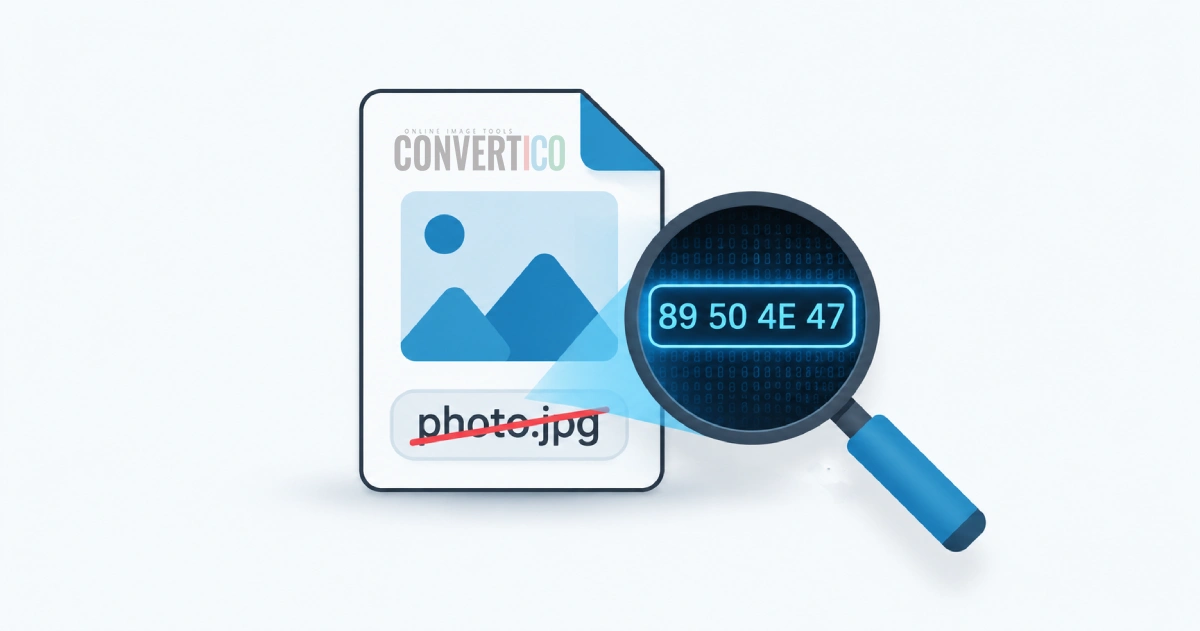

See what is really inside a PNG - every chunk, the bit depth, palette, transparency, DPI and hidden text - and find out why it is so big or will not open. Need it smaller? Try Compress PNG.
Want a smaller PNG without visible change? Compress PNG reduces the colours and squeezes the data.
A PNG is a list of chunks.
Each chunk has a 4-letter name, a length and a checksum.
The analyzer lists every one of them:
| Type | Name | Bit depths | Good for |
|---|---|---|---|
| 0 | Greyscale | 1, 2, 4, 8, 16 | Scans, masks |
| 2 | Truecolour (RGB) | 8, 16 | Screenshots without transparency |
| 3 | Indexed (palette) | 1, 2, 4, 8 | Logos, icons, stickers - smallest |
| 4 | Greyscale + alpha | 8, 16 | Soft shadows in grey |
| 6 | RGBA | 8, 16 | Anything with soft transparency |
An RGBA PNG with an unused alpha channel or a 16-bit PNG of a screenshot wastes space. The checks point this out.
Press Test formats after the analysis - your browser encodes the image as WebP, AVIF and JPG and shows the real sizes.
Drop it into the box above. You get a health score, every chunk with its CRC, the colour type, transparency, DPI and metadata in about a second.
Look at the Transparency line. The analyzer checks the colour type and tRNS chunk, then counts the see-through pixels - so it also tells you when an alpha channel is present but never used.
The usual causes are a cut-off download (no IEND), a damaged signature after an FTP text-mode transfer, CRC errors or a file that is really a JPG or WebP. Each one shows as a failed check. Image Repair can often rescue it.
Yes. You see the frame count, every frame delay, disposal and blend mode, the loop count and the total length.
It is stored in the pHYs chunk and shown in the DPI line. No pHYs means apps assume 72 or 96 dpi. Change it without touching the pixels with the Image DPI Checker.
Yes. Open the Metadata tab - tEXt, iTXt and zTXt chunks are listed with their keyword and text, including generation parameters some AI tools write.
No. The PNG is read entirely in your browser and never leaves your device.